Master: The Story of an Idealist Teacher Lost in the Forest of Power
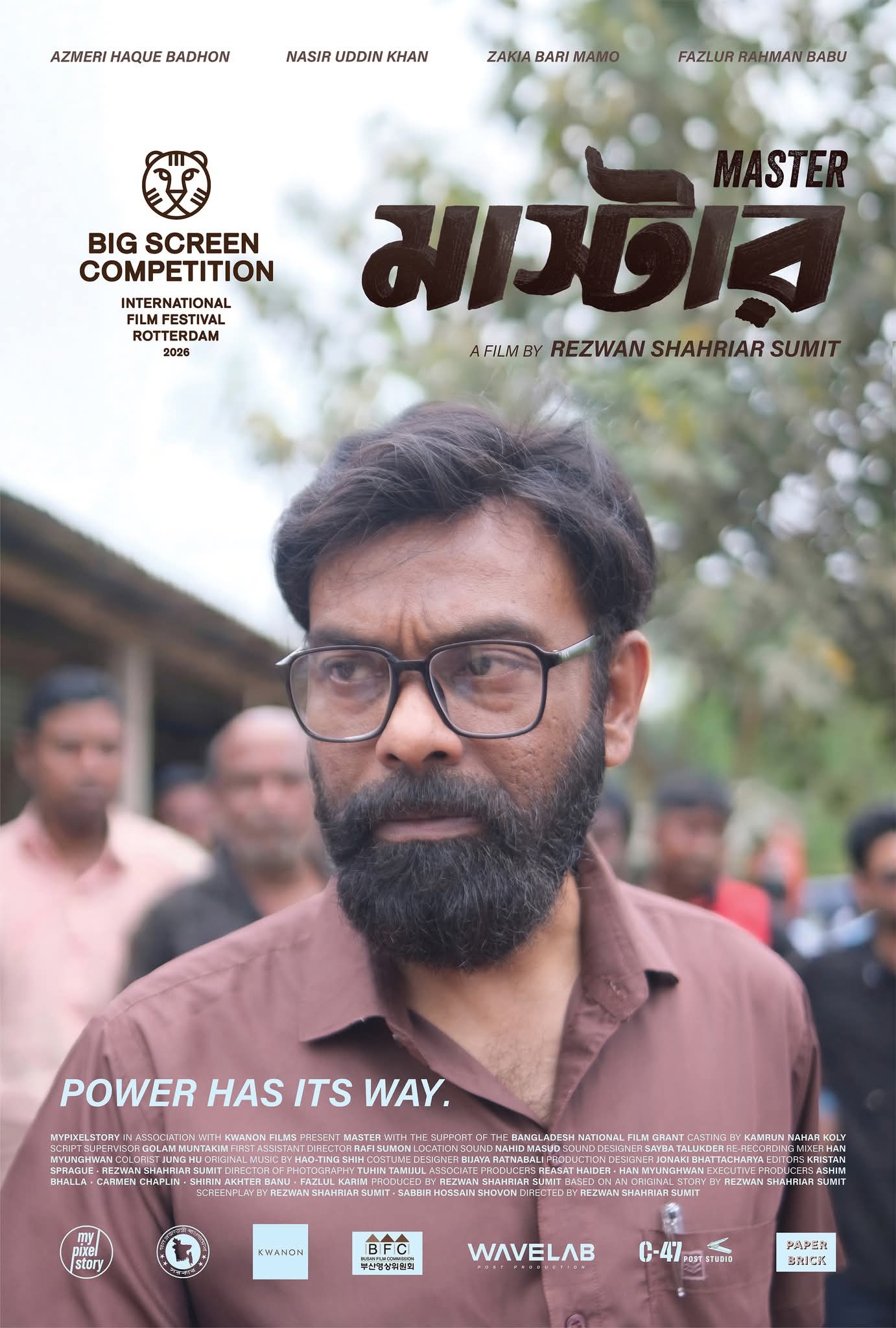
The question of whether Bangladeshi cinema has truly matured is no longer up for debate. In his second feature film, Master, director Rezwan Shahriar Sumit displays such astonishing depth that it’s clear that Bangladeshi cinema has reached a new level of maturity. We saw glimpses of this evolution in films like Sand City, Saba, Ali and Master reaffirms it. Since his debut, Sumit has been a filmmaker of great promise, and with Master, which wasn't just screened in IFFR but also won the Big Screen Competition, he has delivered something truly extraordinary.
The story follows Jahir, an idealistic teacher, a devoted husband, and a loving father. His life revolves around his family and his work, and he is deeply respected by everyone in his community. However, his peaceful life takes a sharp turn when he decides to run for Upazila Chairman in the forest-fringed town of Mohoganj.
One would expect that a man of such high principles would bring positive change to all. But reality proves to be far more complex. Although he takes power with the enthusiastic support of local youth and noble intentions, the crushing weight of public expectation begins to overwhelm him. Unable to ignore the unfair demands of the very people who put him in power, Jahir starts to give in. Slowly, he compromises his values. This erosion of morality creates a painful rift between him and his wife, Jhorna, as well as his closest ally, Aiyub.
The conflict escalates when a proposal arises to evict a slum—led by Aiyub—to build a luxury resort. This brings a new crowd into Jahir’s life: bureaucrats and lobbyists whose influence begins to reshape his daily decisions. His once-selfless dreams are poisoned by a thirst for control, fame, and the intoxication of power.
Throughout the film, the dense forests of Mohoganj serve as a metaphor for Jahir’s psychological struggle. The moment he is elected, the mountain of expectations placed upon him by the common people ironically becomes the very path to his downfall.
It raises a haunting question: When a person gains power, do they change their surroundings, or do the surroundings change them? Jahir wanted to do good, but by stepping into the quicksand of politics, he lost his backbone. When he agrees to bulldoze a childhood playground or a poor settlement for a "luxury resort," the audience feels a shiver of dread deeper than Jahir’s own.
The most heartbreaking part of the film is Jahir’s isolation. As Jhorna and Aiyub drift away, Jahir becomes utterly alone, even while sitting at the pinnacle of power. This loneliness echoes the pages of history, reminding us of Nawab Siraj ud-Daulah, who was left isolated by the betrayals of those closest to him. While Jhorna and Aiyub didn’t betray Jahir—they actually wanted to stand by him—Sumit’s brilliant storytelling makes the comparison feel apt. It is a psychological masterpiece that forces the audience into a deep stream of thought.
Sumit’s cinematography beautifully captures this isolation. The journey from being a beloved "Master" to becoming a feared "Chairman" is portrayed with painful realism.
Master is more than just a film; it is a mirror reflecting the landscape of Bangladeshi politics. It shows how leaders, often elected by the people, eventually crush those same people under the weight of ambition. The film inevitably brings to mind the July Movement of 2024. That movement, fueled by the sacrifice of many lives, culminated on August 5th with the resignation of Prime Minister Sheikh Hasina, ending fifteen years of autocratic rule. Men of principle like Jahir were the driving force behind that movement. But in the end, was that idealism actually upheld? The film Master also confronts us with this very question.
Another question keeps coming back to us: aren't we all a little bit like Jahir at heart? Do we not all distance ourselves from loved ones when lured by some form of power? When Jahir transforms into a tyrant, you feel more pity than hatred for him. He has lost the man that the people of Mohoganj once loved.
Master's screenplay is so strong. The screenplay itself made the film very special in the landscape of Bangladeshi film. And I believe strongly that this film has cemented Sumit's position as a master storyteller. And Master truly inspires us to keep hope for more Bangladeshi cinema that will continue to amaze us.