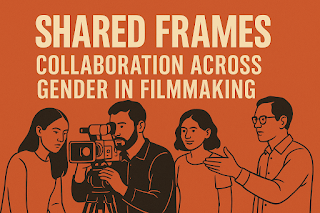
Shared Frames: Why Gender Collaboration in Filmmaking Matters
Written by: Aritro Jolodhi
Founder & Director, Akkhor productions
In the world of cinema, every frame tells a story — but what happens when that frame is shared? Not just between shots or cuts, but between people of different genders, each bringing their unique gaze, experiences, and truths into the creative process. That’s where the idea of “Shared Frames: Collaboration Across Gender in Filmmaking” finds its depth and power.
The Power of Perspective
A film is never just the director’s vision — it is the result of countless collaborative choices. From writing and production design to cinematography and post-production, each layer adds a viewpoint. When those viewpoints represent a spectrum of gender identities, the film transforms into something richer, more layered, and profoundly human.
Historically, cinema has often been seen through a predominantly male lens — commonly referred to as the “male gaze.” While we’ve come a long way in addressing representation on-screen, behind the scenes the gender gap still persists. “Shared Frames” is not just a call for gender balance, it’s a call for co-authorship — for men, women, and non-binary creators to create together, equally and respectfully.
Collaboration ≠ Inclusion
It’s easy to assume that having women on set or in the writers’ room ticks the diversity box. But true collaboration means more than presence — it means participation, decision-making, and shared credit.
Think of a female cinematographer who frames intimacy differently from her male counterpart, or a male director who learns to navigate emotional nuance through a female co-writer. These partnerships don’t dilute creativity — they elevate it.
The Real Impact on Storytelling
- When multiple gender perspectives converge:
- Characters become multi-dimensional.
- Narratives break free from clichés.
- Audiences feel more represented.
- Conversations extend beyond the screen.
From Nomadland’s delicate gaze to The Handmaid’s Tale’s bold defiance, some of the most impactful cinema in recent years was shaped by collaborative minds across gender lines.
Barriers Still Exist
Despite progress, the road to true collaboration is full of friction:
Tokenism — where women are present but not empowered.
Gatekeeping — where decision-making is still largely male-dominated.
Lack of mentorship — especially for emerging female and queer filmmakers.
These barriers are not just systemic; they are cultural. And they can only be dismantled when the industry — and audiences — demand deeper equity, not just surface diversity.
Why Conversations Like This Matter
That’s why panels like “Shared Frames” at Film Fiesta Take 3 are so important. They bring together creators, thinkers, and audiences into a space where tough questions are asked:
- What does real collaboration look like?
- How do we handle creative conflict across gender lines?
- Can we challenge the notion of authorship in cinema?
These aren’t theoretical debates. They influence the stories we’ll watch tomorrow — the ones that might inspire a young girl to pick up a camera or encourage a male director to rethink how he writes women characters.
Shared Frames, Shared Future
A shared frame is a powerful metaphor. It suggests balance. It suggests trust. It suggests letting go of control and embracing co-creation. In a world increasingly polarized, cinema remains a space where empathy can thrive — but only if we allow all voices to be heard, seen, and felt.
So the next time you watch a film and feel something genuine, ask yourself:
Who helped create that moment?
And how many frames were truly shared?
Latest Posts
07 Feb 2026
Where Folklore Meets Reality
02 Nov 2025