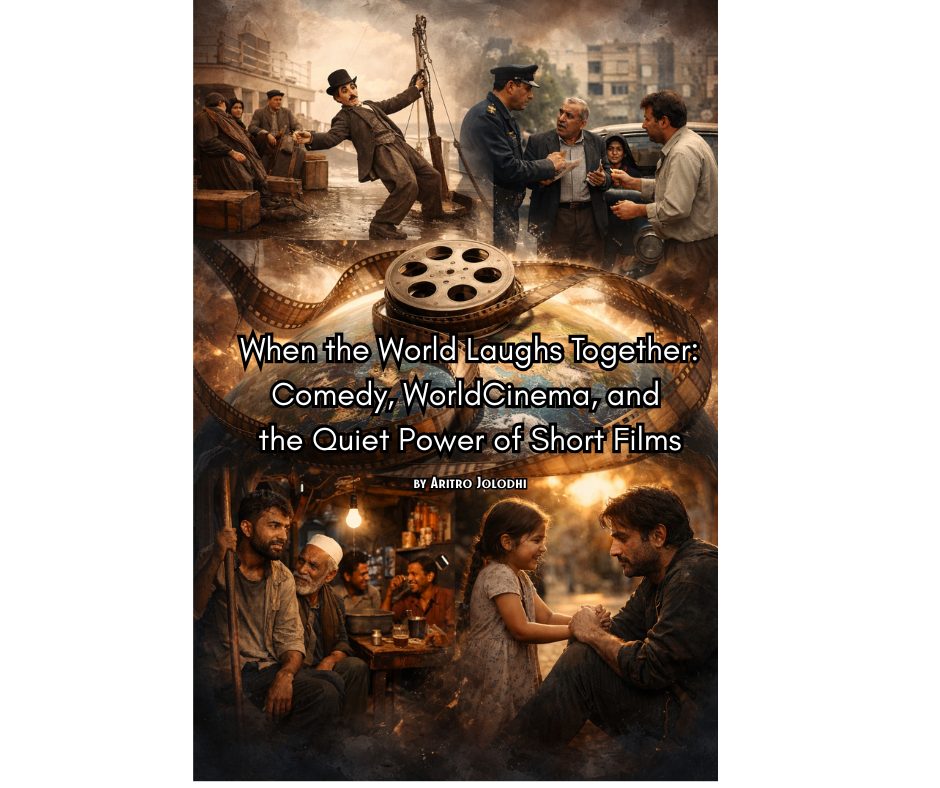
When the World Laughs Together: Comedy, World Cinema, and the Quiet Power of Short Films
by Aritro Jolodhi
It was late at night, the kind of hour where the world outside feels paused, and your attention drifts to small, quiet things. I clicked on a short film I had never heard of — no famous actors, no festival hype, just a thumbnail promising a slice of life. The story began simply: a man waiting for a bus, distracted by the chaos around him. Nothing spectacular. Nothing loud. And yet, within minutes, the ordinary became absurd. A minor misstep, a glance held too long, a reaction just slightly off — and I laughed. Then I paused. Then I felt strangely seen, as if the film had quietly mirrored a truth I didn’t know I was holding.
That, I realized, is the secret power of comedy in cinema. Not the jokes themselves, but the recognition behind them. Comedy, when it works, doesn’t just make you laugh — it lets you feel understood.
Comedy Before Words
Long before dialogue became central to cinema, comedy existed in action, in timing, in human behavior. Charlie Chaplin didn’t need a line to make us understand displacement, poverty, or despair. In The Immigrant (1917), the humor lies in his interaction with the world: slipping on a puddle, juggling his meager possessions, navigating social rules that make no sense. It is funny, yes, but also humane. Buster Keaton in Sherlock Jr. (1924) demonstrates the same principle: the chaos is around him, but his stone face, his deliberate stillness, turns calamity into a mirror — for the audience and for himself.
What these early masters understood, and what modern short films continue, is that laughter is physical before it is verbal. A stumble, a pause, a look that lasts just a fraction too long — these are universal. You don’t need translation. You don’t need context. You just need to notice.
The Pressure and Precision of Short Films
Short films are brutal teachers of comedic timing. They cannot wait for the second act, cannot linger in filler, cannot inflate moments for an easier laugh. Every frame is weighted. Every pause matters.
Take Validation (2007), for example. The premise is deceptively simple: a parking validator gives out compliments. It could have been saccharine. It could have been predictable. Instead, every gesture, every interaction, every delayed reaction layers comedy with warmth and humanity. The laughs come, but they leave a residue — a reflection on loneliness, kindness, and human need.
Unlike feature films, which often escalate comedy with louder jokes and bigger set pieces, short films condense comedy into its essence. A single idea, executed precisely, becomes both the setup and the punchline. Comedy is no longer decoration — it becomes the structure of the story itself.
Observation Over Performance
In world cinema, comedy rarely announces itself. It is not the exaggerated slapstick of commercial formulas, but observation: subtle, quiet, unflinching.
Italian classics like Big Deal on Madonna Street (1958) reveal comedy in incompetence, in human failure. The characters are ordinary, their struggles familiar, and the laughter arises because the audience recognizes the absurdity of their reality. Similarly, Iranian and Eastern European short films often present rigid systems, social rituals, or bureaucratic absurdities that collapse under their own weight. Everyone follows the rules — perfectly — and the humor is in that tension.
Bangladeshi short films carry the same DNA. Here, humor grows from everyday chaos: a crowded Dhaka bus, a family overburdened with expectations, a man protecting pride he cannot afford. Films like A Tale of a Tea Stall or Bhool (Festival shorts) showcase these microcosms of absurdity. Nothing is staged. Nothing is shouted. The comedy is in recognition, in timing, in the delicate pause between expectation and reality.
Comedy and Pain
One of the most remarkable aspects of comedy in short films is how it lives beside pain, not above it.
Curfew (2012) demonstrates this beautifully. A man on the edge of despair is suddenly tasked with caring for a child. The humor emerges from awkwardness, misunderstanding, and the child’s unfiltered honesty. The comedy doesn’t erase the darkness — it frames it, makes it bearable, and, in a strange way, humanizes it.
Bangladeshi shorts often do this too. A character struggling with social norms might trigger laughter not because the audience feels superior, but because we recognize the same constraints in our lives. Humor becomes a shield and a mirror at once.
The Almost-Joke, the Lingering Laugh
Some of the most unforgettable comedy in world cinema comes not from punchlines, but from incompletion. The joke stops mid-step, the pause stretches, the silence lingers — and the audience finishes it.
The Red Balloon (1956) plays with this form of comedy. Its moments are quiet, observational, sometimes mischievous, but never reliant on conventional punchlines. Modern short films, from Europe to South Asia, replicate this method: allowing the audience to linger, reflect, and even laugh hours later at a memory triggered by a subtle gesture.
Bangladeshi shorts, similarly, thrive on restraint. The humor is never announced. The laugh often comes delayed, sometimes uncomfortable, but always deeply human.
Comedy as Connection
In an age of memes, reels, and punchlines optimized for speed and virality, short films reclaim comedy as meaning, not reaction.
World cinema teaches us that laughter can be protest, survival, confession, or quiet agreement between strangers. Bangladeshi short films, though culturally specific, translate beautifully because their humor is behavioral, not verbal. It exists in rhythm, timing, body language, and the unspoken contradictions of daily life.
The father asserting authority he no longer has.
The street vendor negotiating dignity amidst chaos.
A public system insisting on order while producing disorder.
You laugh. You pause. You recognize yourself.
And in that recognition, the laughter ceases to be mere escape — it becomes connection.
Sometimes, all it takes is a small story, a simple setup, and the courage to notice absurdity where life is raw. That’s not just comedy. That’s cinema.
Written by: Aritro Jolodhi

Latest Posts
Where Folklore Meets Reality