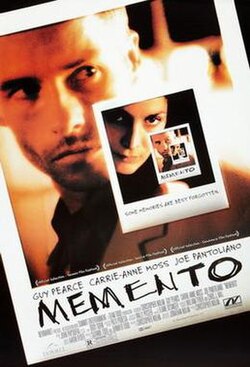
“A Man Who Chose to Forget the Truth: Experiencing Memento”
From the very first frame of Memento, directed by Christopher Nolan, the audience is plunged into a world where logic itself seems broken. A photograph fades instead of developing, a bullet appears to leap backward into a gun, and our understanding of time becomes as unreliable as Leonard Shelby’s memory. In this cinematic universe, cause and effect do not follow a straight path. And yet, the film immediately demands that we engage—not just watch—but piece together a story from fragments.
Leonard Shelby, portrayed with remarkable subtlety by Guy Pearce, is a man trapped by his own mind. He suffers from anterograde amnesia, unable to form new memories beyond a few minutes. Faces blur, conversations reset, and every day is both familiar and alien. Leonard is driven by a singular purpose: to avenge his wife’s murder. On the surface, it seems like a traditional revenge narrative—but as the film unfolds in its reverse chronological structure, we realize that Leonard’s world is far more unsettling than a simple whodunit. He may already have killed his wife’s attacker; he may already be living the very lie he seeks to solve.
To navigate his condition, Leonard creates an intricate system: Polaroid photographs, cryptic notes, and tattoos marking the “truths” he cannot afford to forget. On paper, this system is genius, a methodical attempt to anchor himself in reality. But Memento constantly reminds us that truth is subjective. Leonard’s records are only as reliable as his fractured, emotionally charged mind. He cannot verify the facts he once believed in, and over time, the line between reality and self-deception blurs. He becomes both detective and manipulator—sometimes even a perpetrator of his own delusions.
The narrative’s reverse chronology is its most celebrated and innovative feature. Color sequences move backward in time, while black-and-white sequences move forward, converging at the film’s pivotal midpoint. This storytelling choice is more than stylistic—it mirrors Leonard’s fractured perception of reality. As Narration in the Fiction Film argues, narration structures the audience’s knowledge and understanding. Nolan disrupts this structure deliberately, forcing us to experience disorientation, confusion, and uncertainty—the same psychological states Leonard lives with every day.
Yet, this brilliance carries a cost. While intellectually mesmerizing, Memento sometimes creates an emotional distance. Leonard’s grief, loss, and desperation are always present, but they rarely have the time to resonate fully. Each narrative reset interrupts the emotional arc, leaving the audience understanding his pain but seldom feeling it in a sustained way. According to Engaging Characters: Fiction, Emotion, and the Cinema, audience engagement relies on both alignment (seeing through the character’s eyes) and allegiance (investing emotionally in the character). Memento provides alignment brilliantly but gradually erodes allegiance, as Leonard himself becomes an unreliable guide.
Supporting characters, particularly Natalie and Teddy, share this ambiguity. They are critical to the story’s progression, yet they never fully emerge as independent personalities. Their motivations shift depending on the narrative fragment we are observing—sometimes sympathetic, sometimes opportunistic. From a storytelling standpoint, this mirrors Leonard’s disorientation. But as fully realized characters, they feel more like instruments to serve his journey than as people in their own right.
And yet, the film’s intellectual power is undeniable. It tackles profound themes: memory as an imperfect construct, the subjective nature of truth, and the human need to create narrative meaning even in a broken reality. Following neo-noir philosophical explorations, as discussed in The Philosophy of Neo-Noir, Memento portrays memory not as a recording device but as a constantly edited story. Leonard consciously manipulates his own reality by planting false clues, ensuring that his quest continues indefinitely. In doing so, Nolan raises a disturbing question: how much of our perceived truths are simply lies we tell ourselves to survive?
Cinematographically, the film is equally masterful. Editor Dody Dorn orchestrates the backward and forward sequences with precision, creating tension, disorientation, and thematic depth. The interplay of black-and-white and color sequences not only distinguishes timelines but also evokes the reliability of memory versus the immediacy of experience. David Julyan’s subtle score enhances this psychological tension, with silence often speaking louder than music, echoing Leonard’s isolation and fragmented consciousness.
Still, Memento is not without flaws. Its brilliance can feel self-conscious; the cleverness of its structure sometimes overshadows the story’s emotional core. Repetition—while intended to simulate Leonard’s experience—can become monotonous, and the pacing may feel uneven to some viewers. The film challenges the mind but occasionally leaves the heart wanting.
Final Verdict
Memento is a cinematic experience that challenges as much as it captivates. It is intellectually brilliant and psychologically profound, though at times its structure and ambition create a gap between the audience and the emotional journey of its characte